
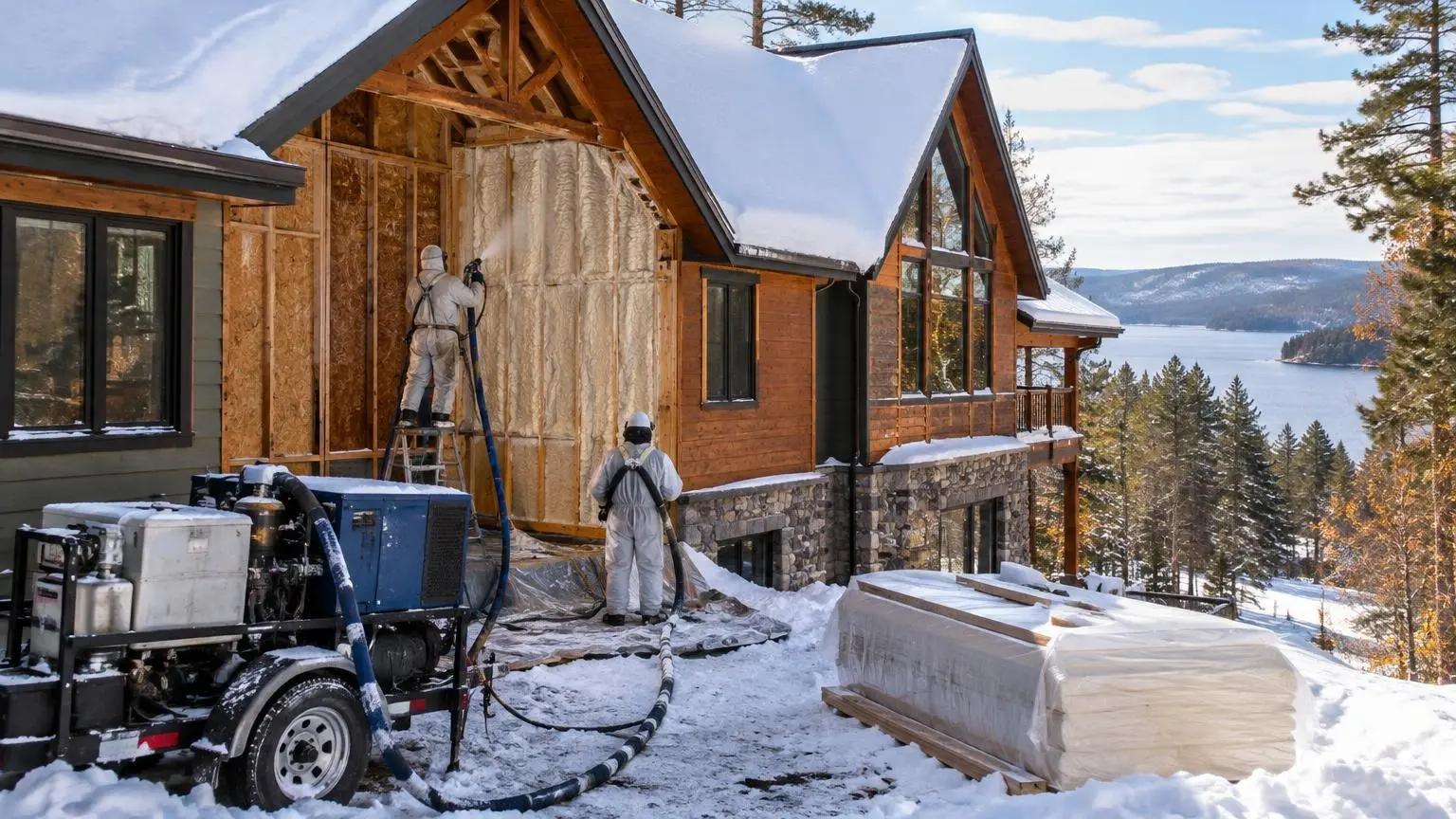
Open-cell and closed-cell foam
Spray Foam Insulation in Gaylord, MI
The right foam for each surface in a Zone 6A house.
- Free on-site estimates
- Itemized quote: material, thickness and R-value per space
- Attic, rim joist and crawl space all checked
Foam Where the Cold Gets In
Spray foam insulation sprays on as a liquid, expands into gaps and cracks, and cures into a solid layer that both insulates and blocks air. In a Gaylord house, with a January daily mean near 16F, the places where cold air and warm, moist indoor air meet are where foam matters most: the rim joist, basement and crawl space walls, kneewalls, vaulted ceilings and the gaps in the attic floor.
Closed cell vs open cell
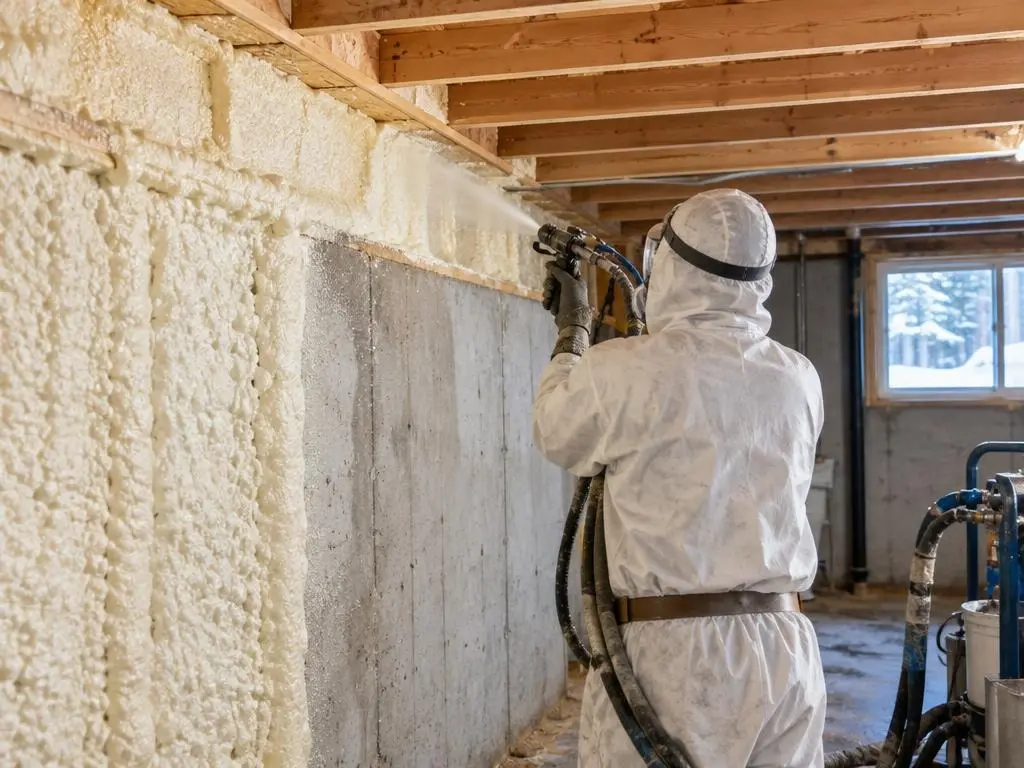
Closed-cell foam is dense and stiff after curing. HomeGuide rates it at R-5 to R-7 per inch. At normal thickness it slows water vapor and does not absorb water. In Climate Zone 6A that makes it the default for any surface that gets cold in winter: rim joists, foundation walls, crawl space walls, the underside of roof decks with no vent space, and steel buildings.
Open-cell foam is soft and expands a lot, at R-3.5 to R-3.7 per inch. It seals air and absorbs sound, but water vapor moves through it, so in this climate it needs a vapor retarder on the warm side. It works in interior walls and some above-grade cavities.
Good uses for foam up north
- Rim joists. The most common foam job, sealing the perimeter where the house sits on the foundation.
- Vaulted ceilings. Cabins and resort homes often have cathedral ceilings with no attic; closed-cell under the roof deck reaches high R-value in shallow rafters.
- Cabin floors and crawl spaces. Foam on crawl space walls brings the space inside the house and protects plumbing.
- Attic bypasses. Foam seals the gaps before blown-in goes on top.
- Pole barns and shops. Foam on steel stops condensation.
When foam is not the answer
On a large open attic floor, sealing and blowing in cellulose or fiberglass reaches R-60 for less. Foam should never cover wet framing or a leak. Old wiring and suspect vermiculite get flagged before anything is priced.
Cold-weather application
Foam needs the surface and material within a working temperature range. In a heated basement that is easy any time of year. Unheated attics, crawl spaces and buildings may need to be warmed or scheduled for a milder stretch. HomeGuide advises staying out of the house at least 24 hours after spraying.
Where We Spray
Common foam jobs around Gaylord:
Rim joists
Closed-cell around the basement perimeter.
Basement and crawl space walls
Closed-cell on concrete and block.
Vaulted and cathedral ceilings
Closed-cell under the roof deck.
Kneewalls
Seal and insulate story-and-a-half spaces.
Steel buildings
Closed-cell on walls and roofs.
Published Spray Foam Costs
| Job | Published range (source) |
|---|---|
| Spray foam, installed | $1.50 to $5.00 per sq ft (HomeGuide) |
| Open-cell / closed-cell | $1.50 to $3.50 / $3.00 to $5.00 per sq ft (HomeGuide) |
| Roughly 1,000 sq ft | $1,500 to $5,000 (HomeGuide); $3,150 to $7,500 in an existing home (Fixr) |
| Rim joists, spray foam | $2,000 to $2,500 (HomeGuide) |
| Existing walls / new construction | $3.15 to $7.50 / $2.75 to $6.50 per sq ft (Fixr) |
| Whole house | $8,000 to $20,000 (HomeGuide); $10,000 to $30,000 (Fixr) |
| Common job minimum | $1,000 to $2,000 or more (HomeGuide) |
National ranges from HomeGuide (2026) and Fixr (2025). Foam type, thickness, access and travel to lake properties change the total, and small jobs often hit a minimum. Your written estimate is the price.
Foam Job Steps
1. Inspect
Spaces measured, moisture and wiring checked.
2. Quote
Foam type, thickness and R-value per area.
3. Prep and spray
House protected, ventilation set, foam applied in passes.
4. Finish
Thickness checked, cleanup, re-entry timing confirmed.
Spray Foam Insulation Questions
Which spray foam has the highest R-value?
Closed-cell, at R-5 to R-7 per inch per HomeGuide.
Can you spray foam in winter?
Inside heated spaces, yes. Cold spaces need warming or a milder day.
How thick is foam on a rim joist?
Typically 2 to 3 inches of closed-cell.
Does foam stop mold?
It prevents condensation on the surfaces it covers, which removes a common cause. Existing mold and leaks come first.
Spray Foam Insulation Service Areas
- Spray Foam Insulation in Gaylord, MI
- Spray Foam Insulation in Vanderbilt, MI
- Spray Foam Insulation in Johannesburg, MI
- Spray Foam Insulation in Wolverine, MI
- Spray Foam Insulation in Indian River, MI
- Spray Foam Insulation in Boyne Falls, MI
- Spray Foam Insulation in Boyne City, MI
- Spray Foam Insulation in Grayling, MI
- Spray Foam Insulation in Lewiston, MI
- Spray Foam Insulation in Atlanta, MI
Get a Spray Foam Insulation Estimate
Tell us which spaces you want foamed and we will price each one.